Have you been diagnosed with Myotonic Dystrophy Type 1 (DM1) or Type 2 (DM2)?
Have you been diagnosed
with Myotonic Dystrophy
Type 1 (DM1) or Type 2 (DM2)?
Learn more about clinical research studies evaluating if mexiletine prolonged release (PR) is safe and effective in alleviating muscle stiffness and improving quality of life.
Have you been diagnosed
with Myotonic Dystrophy
Type 1 (DM1)
or
Type 2 (DM2)?
Learn more about clinical research studies evaluating if mexiletine prolonged release (PR) is safe and effective in alleviating muscle stiffness and improving quality of life.

About the HERCULES Study
The HERCULES clinical study is investigating mexiletine prolonged release in patients with myotonic dystrophy type 1 or type 2 (DM1 or DM2). Mexiletine is a well-known medicine, already approved for easing the symptoms of myotonia in non-dystrophic myotonic disorders. HERCULES is the first study involving DM patients to evaluate the safety and effectiveness profile of mexiletine prolonged release (PR), in alleviating muscle stiffness and delayed relaxation (myotonia), supporting daily activities and quality of life.
Half of the patients in the study will receive mexiletine as a newly developed prolonged release (PR) formulation (the “investigational medicine”), while the other half will receive placebo (a treatment with no active ingredient). Patients taking part will be randomly assigned to one of these two treatments, and neither they nor the study team will know which treatment is being given. Patients joining HERCULES will be asked to stay in the study for six months. The dose of mexiletine PR will be increased gradually over the first two weeks to 500 mg mexiletine.
The HERCULES study will include a total of 96 patients at several hospitals (“study sites”) across several countries in Europe (including the United Kingdom).
You may be eligible to join the study if you are:
- At least 16 years of age*
- Genetically diagnosed with DM1 or DM2
- Can walk independently for 10 metres (with a cane, walker or orthoses, if needed)
- Weigh 45 kg or more
- Are not pregnant
* below 18 years, an approval from a responsible adult is needed

About Myotonic Dystrophy
Myotonic dystrophy (Dystrophic Myotonia, or DM) is an inherited neuromuscular disease that causes progressive muscle weakness, muscle wasting, muscle stiffness and delayed relaxation (myotonia). There are two types of myotonic dystrophy. DM1 (also called Steinert disease) is the most common form in adults and starts as early as childhood or in early adulthood. DM2 (also called PROMM) typically starts later in life and is milder than DM1. The main symptoms can affect the muscles, eyes and heart, as well as the endocrine and metabolic systems.
There is no cure for myotonic dystrophy, but the main symptoms can be managed. The HERCULES study aims to target muscle stiffness and delayed relaxation (myotonia), as this is a limiting and sometimes painful symptom for people affected.
About Mexiletine
Mexiletine (NaMuscla®) is an approved (as a capsule) treatment in several European countries for easing the symptoms of myotonia in adults with non-dystrophic myotonic disorders (NDM). It helps to improve these patients’ quality of life.
Mexiletine is currently being developed to help reduce muscle stiffness (myotonia) in people with DM. In the Hercules study, a new form of mexiletine is being tested. This is called mexiletine prolonged release (PR). Unlike the NaMuscla® capsule, this new formulation is provided as a powder that is mixed with water and taken as a drink. This was designed to make the medicine easier to swallow and better tolerated. The prolonged release aspect means that the medicine is released slowly and gradually into your body over time. This is different from the NaMuscla® capsule, which releases the medicine all at once shortly after you take it.
Study Participation
You may be able to join the study if you:
- are aged 16 years or older*,
- have a genetically confirmed diagnosis of DM1 or DM2,
- weigh 45 kg or more,
- can walk independently for 10 metres (with a cane, walker or orthoses, if needed),
- are not pregnant.
* below 18 years, an approval from a responsible adult is needed
If you can answer “YES” to all these questions, you might be able to join the HERCULES study. There are several countries and sites where the study is taking place. Please check which site is most convenient for you and get in touch if you’re interested in joining: study sites.
A medical doctor at one of the study sites will carry out all the final checks to see if you’re eligible to join the study. The study site is the hospital where the study is taking place. Only you can make the final decision whether to take part. Your study doctor will be there to answer all your questions.
Please remember that taking part is entirely your choice and that you can leave the study at any time, without giving a reason. Leaving the study will not affect your medical care or legal rights.
If you’re unsure whether joining this study is the right choice for you, feel free to speak with your doctor who knows you and your medical history.

What Will I Be Asked To Do?
If you’re eligible and willing to take part in the HERCULES study, you’ll be asked to attend six in‑person appointments and have two phone calls with the study team. These visits and calls take place over a 26‑week treatment period.
If you’re interested in joining the study, you can find a more detailed schedule below:

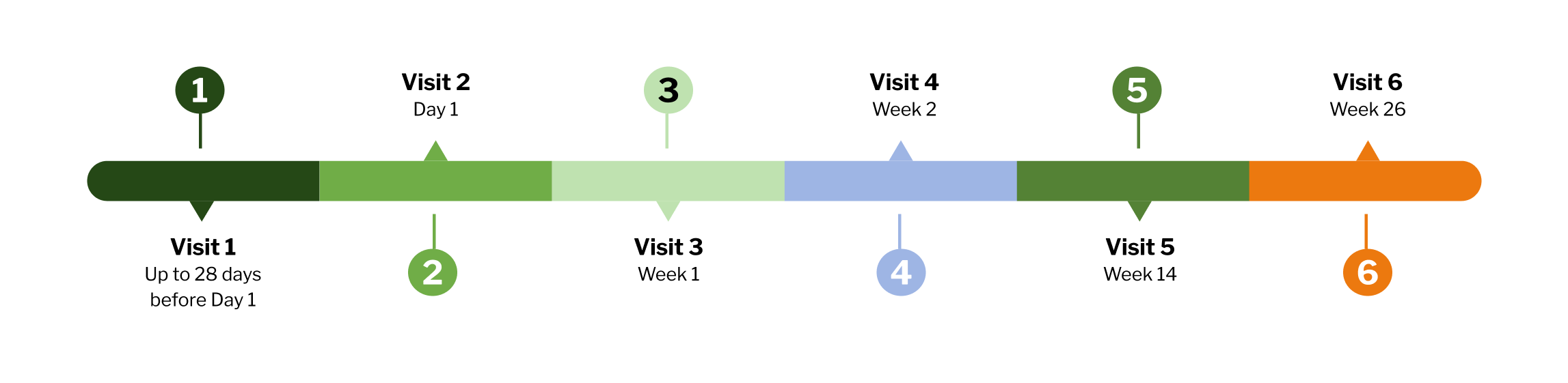
Please note that the information below includes only a selection of the assessments conducted during the study. Not all assessments are listed.
Visit 1:
At Visit 1 (“Screening”), the study team will carry out a first set of general checks (e.g. laboratory measures, physical examination, blood and urine tests, heart check) to see if you’re eligible to join the HERCULES study.
Visit 2:
At Visit 2, DM-tests (including filling out questionnaires) will be done to define your “baseline values” before you start to take the study medication. Other measures of safety (e.g. ECG, vital signs) will also be checked again. You’ll start to take your study medication once daily from Visit 2 onwards. You’ll receive the study medication to take at home, along with instructions on how to take it and how to track your use.
Visit 3: and visit 4:
At Visits 3 and 4, measures of safety (e.g. ECG, vital signs) will be checked again.
Visit 5:
At Visit 5, more safety tests (e.g. urine and blood tests, vital signs, ECG, physical examination) will be done. DM-tests (including filling out questionnaires) will also be carried out.
Visit 6:
At Visit 6, safety tests and DM-tests will be performed. This will be the “end-of-study” visit in the HERCULES study.
In addition to the six on-site visits, your study team will call you twice—at weeks 8 and 20—to check e.g. on how you’re feeling.
Support for travel arrangements
If you take part in the HERCULES study, all study-related activities and medication will be provided at no cost to you.
The study sponsor has provided a concierge service for most of the participating study sites (currently not available in Denmark) to support you with travel arrangements (e.g. taxis, flights, hotel accommodation) if needed. This means, within the eligible countries, patients may either have travel arranged in advance at no upfront cost or arrange their own travel and be reimbursed based on submitted receipts, in accordance with local regulations and sponsor-defined cost limits. Your study site will coordinate everything directly with the concierge service, and your study nurses will work with you to arrange all necessary details.
After you’ve finished taking part in the HERCULES study, you’ll have the option to join the follow-up ATLAS study.
There are many meaningful reasons to consider joining the HERCULES study:
- The treatment could potentially improve your myotonia symptoms.
During your treatment, medical staff will monitor your health closely, to ensure accurate collection of safety and effectiveness data within the DM population.
- By taking part, you’ll contribute to the potential development of a future approved treatment option that could benefit both you and others living with this condition.
- After you complete the HERCULES study, you will have the option to participate in the follow-up study called ATLAS. In the ATLAS study, all participants can receive the study medication, mexiletine in a prolonged‑release form. ATLAS is an open‑label study, which means both you and the study team will know which treatment you are receiving.
Although the use of mexiletine in myotonia is endorsed by physicians and patient groups, official approval of usage in DM requires supporting evidence from a clinical study, such as HERCULES.

Professor of Paediatrics, Department of Child Neurology
UKGM University Hospital Giessen, Germany

By joining the HERCULES study, you are helping to advance research that could lead to better treatment options for people living with myotonic dystrophy. Your participation may make a meaningful difference in understanding this condition and supporting future therapies for the DM community.

Belgium
Study Site Name: UZ Leuven
Herestraat 49 3000 Leuven – Belgium
Email: kristl.claeys@uzleuven.be (Prof. Kristl Claeys)
Denmark
Study Site Name: Aarhus Universitethospital
Neurologisk Forskning Palle Juul-Jensens
Blvd. 99. Aarhus, 8200, Denmark
Study Site Name: Rigshospitalet
Klinik for Nerve- og Muskelsygdomme & Copenhagen Neuromuscular Center
Afsnit 8077, Copenhagen, 2100, Denmark
Email: nicolai.rasmus.preisler@regionh.dk
Germany
Study Site Name: University Hospital Essen
Hufelandstraße 55, 45147 Essen, Germany
Telephone: +49 201-72385563
Email: NME.Studie@uk-essen.de (Prof. Dr. med. Tim Hagenacker)
Study Site Name: Neuromuskuläres Zentrum Göttingen
Robert-Koch-Straße 40, 37075 Göttingen, Germany
Telephone: +49 551-39065760
Italy
Study Site Name: Ospedale Niguarda – Nemo Clinical Center Piazza Ospedale Maggiore
3 Blocco Sud, Pad 7, Ala D, piano 2, 20162 Milano MI, Italy
E-mail: crc_rsu@centrocliniconemo.it
Study Site Name: Azienda Ospedaliera Universitaria Policlinico Tor Vergata
Viale Oxford 81, 00133 Roma, Italy
E-mail: neuromuscolare.ptv@gmail.com
Study Site Name: Fondazione IRCCS Ca’ Granda Ospedale Maggiore Policlinico
Via Francesco Sforza n. 35, 20122 Milano, Italy
Telephone: +39 02 55033802
Email: giacomo.comi@unimi.it (Dr. Giacomo Comi);
info@fondazionemalattiemiotoniche.org (Prof. Giovanni Meola – Myotonic Disorders Foundation)
Study Site Name: Fondazione Policlinico Universitario Agostino Gemelli IRCCS
Largo A. Gemelli 8, 00168 Roma, Italy
Telephone: +39 06 30154338
Email: gabriella.silvestri@policlinicogemelli.it (Dr. Gabriella Silvestri)
Spain
Study Site Name: Hospital Universitario Basurto
Montevideo Etorbidea 16-18, 48013 Bilbao, Spain
Email: Neuromuscular.osibilbaobasurto@osakidetza.eus
Study Site Name: Hospital Universitario y Politécnico La Fé
Avenida Fernando Abril, Martorell 106, 46020 Valencia, Spain
Telephone: +34 630306333244153
Email: martacampo.lafe@gmail.com ; lujan_diago@iislafe.es
Study Site Name: Hospital Universitario 12 de Octubre
Avda de Cordoba, s/n, 28041 Madrid, Spain
Email: neuromuscular.hdoc@salud.madrid.org
United Kingdom
Study Site Name: National Hospital for Neurology and Neurosurgery
University College London Hospitals NHS Foundation Trust
Queen Square, WC1N 3BG, London, United Kingdom
Email: n.nikolenko@nhs.net (Dr. Nikoletta Nikolenko)
Study Site Name: The Robert Jones and Agnes Hunt Orthopaedic Hospital
Gobowen Oswestry SY10 7AG, United Kingdom
Telephone: +44 01691 404142
Email: rjah.researchoffice@nhs.net
Study Site Name: St George’s University Hospitals NHS Foundation Trust
Blackshaw Road, London SW17 0QT, United Kingdom
Email: neurogenetics@stgeorges.nhs.uk (Mark Mencias)